Research TOPICS
Quantum phenomena in silicon devices
Quantum technologies will be one of the defining technologies of our future. Quantum mechanical phenomena enables creating new kinds of sensors, communication methods and computers. The realisation of a quantum computer would be a major shift in the computing capabilities of the human kind, and we can dream of e.g. full simulations of biological phenomenon.
We study how quantum computer components and quantum sensors could be realized using silicon, which is the current material basis all modern information technologies. Using silicon for quantum technologies would enable leveraging the existing huge fabrication infrastructure and allow easy integration to classical electronics and photonics.
On the fundamental side, we aim to probe the possible size and time limits of quantum phenomena, by coupling long coherence time qubit systems to massive quantum oscillators.

Spin – optomechanics
Donor spins in silicon are one of the most coherent quantum system in solid state. They however still lack convenient coupling and readout mechanisms. Here we aim to solve these issues by coupling the spins to silicon optomechanical structures, allowing for optical readout and phononic coupling between spins.
Additionally, the coupling between the long coherence times spin qubits and semi-macroscopic mechanical resonator opens up possibilities to study the possible time and size boundaries of quantum effects coming from e.g. gravitational effects.

Spin – photonics
Silicon photonic crystals give us a flexible method to both guide light on chip and concentrate it in cavities where light-matter interaction can be maximised. We study photonic crystal structures to combine them with emitters in silicon that also have a spin degree-of-freedom. Special interest lies in helical waveguide structures.
We also study the donor bound exciton transitions for a hybrid electro-optical spin readout.

Quantum control of mechanical systems
The optomechanical structures we work with are suspended photonic crystal structures. We mostly work with devices deep in the non-resolved sideband limit where the outgoing light reflects directly the instantaneous position of the mechanical oscillator. This allows using the toolbox of measurement based back-action for the control of the mechanical system. We are especially interested in pulsed measurements and feedback.

Integrating donor spins and commercial quantum dot devices
Here we will develop readout methods for donor spins based on a resonant spin-dependent bound exciton transition which we will excite using resonant lasers and detect using on-chip detectors based on the silicon quantum dot devices produced by the start-up Semiqon Oy. This readout can work at low magnetic fields and 4 K temperatures. The project is done in close collaboration with Semiqon Oy. The integration of commercial silicon quantum dots, donor spins and silicon photonics will produce a novel quantum sensing and quantum computing platform with both research and commercial potential.
Research infrastructure
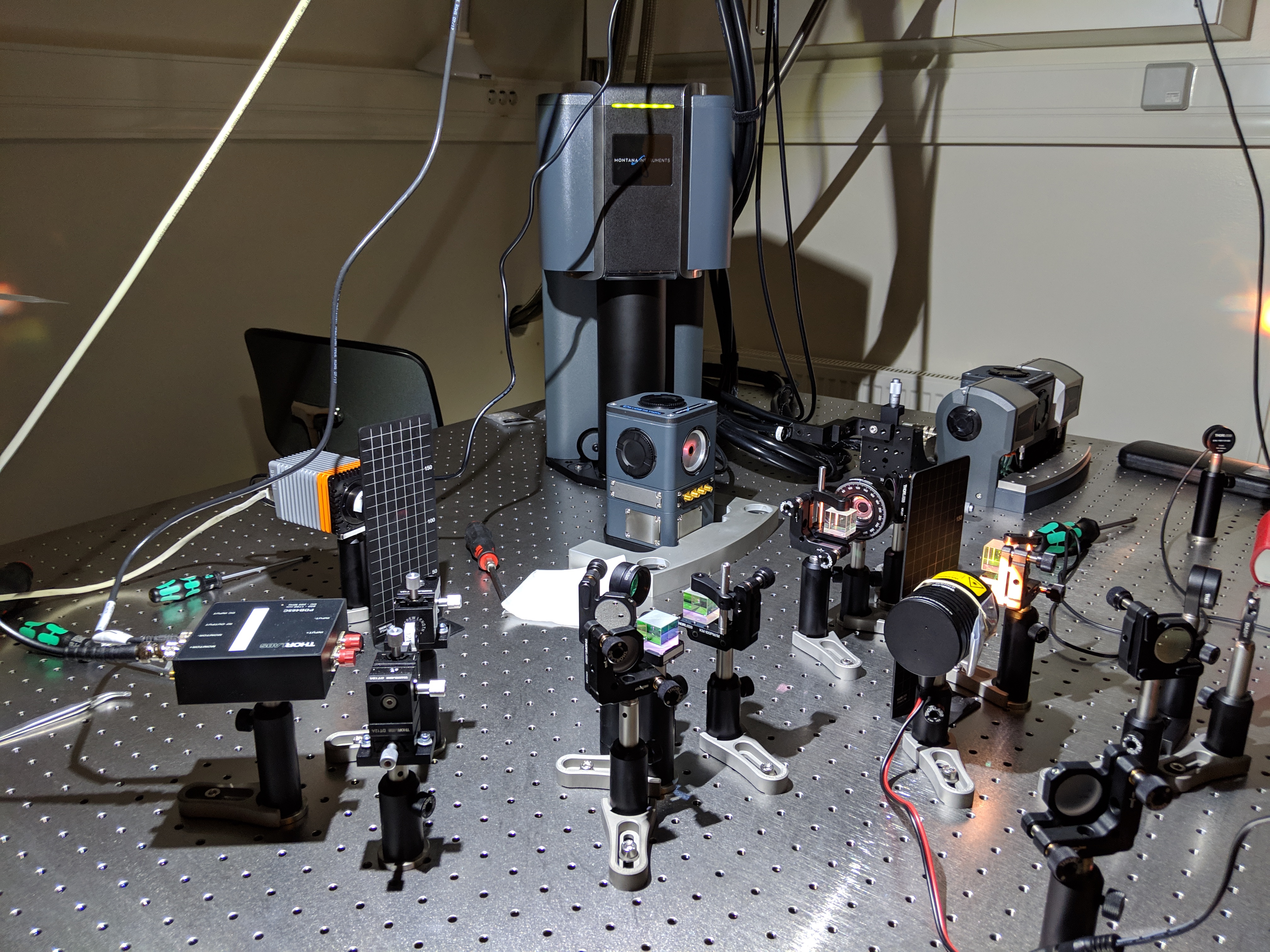
Our measurement lab has several optical setups around a 4 K cryostat (Montana Cryostation C2) and a dilution refrigerator (Bluefors LD400). Both allow also electrical addressing up to 40 GHz, we have sources and a VNA up to these frequencies. We use mainly continous wavelength tunable diode lasers at the telecom range around 1550 nm.
Nanofabrication is done in the cleanroom of the Nanoscience Center, which has all the needed capabilities from electron beam lithography to metal evaporation and ICP-RIE etching.
 MAIN
MAIN 